
Alan might be fighting a cause that can never be won but it is a battle worth fighting.

Professor Sugata Mitra is an advocate of allowing children to use their innate abilities to learn through the use of technology and learning in groups. He is currently Professor of Educational Technology at the School of Education, Communication and Language Sciences at Newcastle University, UK.
His now famous Hole in the Wall experiment was the inspiration for the Indian author Vikas Swarup to write his first novel which was then to become the movie Slumdog Millionaire!
The hole in the wall experiment involved placing a computer kiosk in the wall of an Indian slum in Dehli to observe how children would use it. The experiment was established to prove that children could learn how to use computers without any formal training. The experiment has since been repeated at many places in India, Cambodia, Africa and within the UK with amazing results.
The HIWEL (Hole In the Wall Education Ltd) team have undertaken both qualitative and quantitative analysis of the various experiments covering a range of measures such as Academic performance and Peer to Peer Learning Patterns.
What this might say about the education of children in developed countries is both interesting and challenging as Professor Mitra says that his findings are not restricted poor families in other countries but for any child which could be said to be 'remote'. He suggests that the word 'remote' could apply to children in rural locations or in cities anywhere in the world.
If children can work collaboratively to solve shared problems using technology to support their learning and they appear to do this more effectively than would otherwise be the case then why do we need teachers?
What Professor Mitra is saying does not actually remove teachers but it does change their role and it raises important questions about our approach to teaching and learning, particularly for very young children and opportunities they have for working with technology in groups.
Interesting to consider whether the collaboration always needs to be working together on the same machine rather than working in online communities.

Dave Seddon is headteacher of Baxter College in the Kidderminster area of Worcestershire, UK. When he arrived at the school he faced a huge challenge with a school that was deemed to be failing, had falling student numbers and was in an ageing building that seemed well matched to the then aspiration of the school.
He has turned the school around in a remarkably short time and won the Public Servants of the Year Award in 2006 for his achievement. Dave has very strongly held views about the creation and sustainability of effective learning environments and he set these out in a Powerpoint presentation he made which is now posted on the Specialist Schools and Academies Trust website. The presentation makes clear Dave's' determination to make a difference to the lives of the young people in his care and shows just what an impact he and his new revitalised team has made.
The educational turnaround has been made of of many components, together combining to have a powerful effect on the school. Among the mix of issues was the nature of the building and his efforts to make changes to better reflect the atmosphere and culture to more closely fit with his own vision for the school.
I spoke to Dave about the work he has been doing and some of the challenges he faced and still faces and a podcast of part of our conversation is with this post.
Addition: Dave Seddon was awarded an OBE (Order of the British Empire) by the Queen in her 2013 Birthday Honours list for services to Education.

 I have long thought that we need to develop a carefully crafted model for the learning environments of the future, particularly for students in the state school system attend compulsory education.
Research into the views of young people about their school experience reveal that many feel that it is not meeting all of their needs. If we are intent on delivering personalised learning then we need to listen to young people and build environments. Both physical and virtual, within which they can flourish.
Students also say that they want to be able to engage with other young people and in many cases the opportunities to do this are either difficult to arrange or are not sustained over long periods and are limited to specific projects.
The safe space of a learning platform or VLE, where learners are supported in their formal learning, combined with the more open global tools, where greater opportunities for social interaction become possible, must be our ultimate goal as educators. Our aim should be to ensure that we support learners effectively in their formal learning while allowing them to explore ideas and interests with each other. We also need to reach out to other learners world wide rather than requiring them to enter our closed managed online worlds which may well restrict the nature and extent of the discussion that can take place.
The diagram here shows how we could create much more stimulating online worlds. The use of RSS feeds are probably one of the most powerful ways of linking these external systems into the safer spaces without the need for complex API interfaces and authentication. Educators can ensure that their learners are aware of the risks associated with online system while harnessing them to serve the education process. A larger image is available here.
I would be interested to here how educators and/or learners use these different spaces and just what the impact of this approach might be.

In the local research, which was focused on the 14 to 19 age group in a number of UK schools, it was found that the opportunities provided by online collaborative spaces is actually having an impact on these ‘quiet’ learners. The report stated that;
"There appears to be a particular emphasis of certain impacts on ‘quiet’ boys (even though there were fewer of these that self-reported as being ‘quiet’), but the impacts on both groups were potentially important. It should also be noted that ‘quiet’ is likely to encompass at least three different groups of learners: those who are naturally reticent in terms of offering their ideas in classrooms; those who find difficulty for emotional or social reasons with engaging in a classroom learning environment; and those who do not want to be seen by others as being engaged or interested in the topic or lesson."
Many learning environments that are solely concerned with course delivery or assessment may well be missing a trick as the true potential appears to come from extending the routes by which learners can engage with the learning process even where the actual engagement is more about meeting their personal needs or providing an outlet for social interaction.
If we are determined to provide learner access to online learning then it must go well beyond access to content, their coursework or communication between teachers and their class group. The greater the opportunity to collaborate and communicate the greater the opportunity for quiet learners to find their voice.
The development of tools for social interaction and which foster collaboration and membership of online communities has exploded in recent years. Myspace, Flickr, Bebo etc are all sites which draw people in, share their identities and interests and then share in all sorts of ways (some not quite legal).
There are tensions in the educational world regarding such technologies. Leading advocates like Steven Downes would claim that Web 2.0 will provide massive opportunities for learning but absolutely not in the traditional school or even a school at all. Others say it is the way forward and it has a significant contribution to make to, what you might call, more formal education.
The term Learning 2.0 was coined (I guess) by those advocates of Web 2 technologies to claim the educational ground and to promote their vision of the way the future of learning should go. Learning 2.0 is really what Wikipedia would refer to as e-learning 2.0 i.e. the second generation of e-learning tools based around collaborative tools such as wikis and blogs etc.
Most innovations in learning and which have an ICT component have come and gone - remember the CD ROM? We have been through a whole raft of software and hardware systems which we have put into schools. In most cases the ones that stick are those that seem best to fit the traditional mode of teaching and learning e.g. Learning Platforms as course delivery systems or whiteboards which look a lot more interesting that black ones but still hang on a wall at one end of a room and have everyone looking at it!
The same fate may lie in wait for Web 2.0 and e-learning 2.0 if we try to fit it into the standard school setting other than to be used by a few interested people with a passion for exploring at the edges of what we still refer to as schooling.
Alan November was asked a question about the relationship between web 2 and learning 2 at a recent conference - although the audio is poor his comments are pretty realistic.
What constitutes a community? Are online communities real communities? Are online communities important for education?
Users of YouTube think they are a community........
Research about communities is extensive - do a search on Google Scholar and you get 9 million hits, try Learning Community and you get 1.8 million with the top hits leading to some of the leading thinkers in this area. From my reading around this I was attracted to the definitions of 'community' presented by Kowch and Schwier (1997) where they describe four different types of community, each with distinguishing features and which meet the needs of different groups of participant. Reil and Polin (2004) explore the notion of online communities and identify three different types. Task based communities tend to be where groups of people are working on a common task or problem. Practice based communities often share goals or expertise and knowledge based communities are often people who come together with diverse expertise and can establish new areas of knowledge.
This all sounds grand but I wonder just how the notion of community sits within our education system. We don't assess group contribution or how well students share expertise or work together to create new knowledge - at least that is the case in many school I visit. We only seem interested in assessing the individual or what contribution they make to the 'community' (usually through social good works). Seems to me that we have much to do to explore online educational communities and harness them for learning.
The question remains - is the YouTube Community a real community?

confident individuals who are able to live safe, healthy and fulfilling lives
responsible citizens who make a positive contribution to society.
What society wants from the education system is changing all the time although for many it still appears to provide more or less the same diet as we have seen for the past hundred years or so.
We are in a connected world and there are resources for learning in all sorts of formats along with the opportunity to communicate and collaborate with individuals and groups from around the world. Never before has there been something that had such an impact on the education process as has the advance in technology and the internet. We need to think carefully about how the use of technology will affect the design and delivery of the curriculum in our schools.
The question is how much will the curriculum be allowed to change? How much can we accommodate these new ways or working and how ready are our pedagogues to accomodate the use of technology to allow the changes to take root?
Some would suggest that nothing much will change. The subjects we are used to have been around for ages. Others argue that young people now have more choice than they have ever had and that the social networks and other communities online will be the future for formal education.
Most probably we will end up somewhere between the two extremes. We will probably have schools for a long time to come, they will have teachers (but perhaps fewer specialists), we will have more adults working with kids (teaching assistants and mentors from outside the school etc), we will have online spaces (but these may be simply extensions of a particular classroom and not dynamic communities). We are already seeing a mix of provision with some internships or work placements as part of the learner's programme and we are seeing ideas for building the curriculum to deliver the standards that seem to be a political imperative and yet have been formed into a more project based structures.
The nature of educational change is that it is normally a slow process. That said the rapid development of alternatives as technological provides interesting and attractive alternatives will result in huge pressure to speed the change process. We await with interest the results.

The photograph below shows the timetable - not a list of subject sessions one after the other but a series of advisory sessions to support learners with their personalised programmes. Subject knowledge does feature in the study programmes but they are shaped to apply to the particular requirements. Where a number of students are following programmes that require the same knowledge base then they are taught as a group.

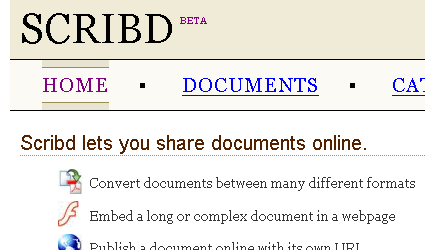
It was launched in 2006 and now has around 140,000 documents in its database. A browse of the groups contained within Scribd shows the extent of the collections with some very interesting vintage print adverts, material on Wen 2.0 and even some open text books. Trouble is that, as you might guess the adult section contains the most resources , some 17,000 making it a difficult resource to see used in schools.
Ask a student where they get most of the support for their school coursework and you might expect them to say their teachers.
489 students responded to a poll in our online learner community and they produced some interesting results.
Q. Where do you get most of your information to support your coursework?
School Intranet 1.23% (6 votes)
The Internet (Via Google etc) 51.12% (250 votes)
Teachers during lessons 37.83% (185 votes)
Online Learning Space 2.86% (14 votes)
Other Students 6.95% (34 votes)
Total number of votes: 489
The results pose some interesting questions. Should we be pleased that so many are using the web or should we be concerned that so many are turning to the web rather than their teachers? There are a number of possible reactions to this sort of information. Firstly are we actually preparing learners for the effective use of the web or do they simply decide that they can find most things they need from this source?
How many courses in schools actually teach the efficient use of the web and effective searching and citation. Many teachers say that a large number of students tend to produce the same sort of information when using the web for coursework and in some cases the teachers can actually tell which web sites students have used. Is this a good or bad thing? Are there skills that learners need to be taught and are our teachers knowledgable to teach those skills?
Loads of questions but very few answers. We are only beginning to unpick the implications of all this for education and the approriate curriculum for the 21 century learner - interesting to speculate where it is all going.


This e-book explores Learning Spaces from the perspective of effective learning and how learner expectations may influence their development.
It also covers the roll of learning technologies in bringing together different groups of people and specialisms all of whom can impact on the learner and the learning that takes place. While the e-book looks at learning spaces other than Primary and high schools a lot of the basic ideas apply and the discussion surrounding the desire to create more flexible spaces, both the physical and virtual ones, is of real value.
There is useful debate about formal and informal physical spaces and the importance of striking the correct balance to create the 'correct' environments for learning. The book opens up the debate about the role of technology as part of the mix and suggests that while learners are have more access to technology and they are comfortable using it many are still not proficient. This presents real issues for those schools and other educational organisations that see e-learning as a key component of personalisation.
The many VLE type products out there may provide alternative routes but the assumption that students can use them straight off and value the experience is open to question. The book also explores the issues surrounding the notion of community and identifies some of the ways in which a well designed virtual learning space can contribute to the development of an effective learning environment. The full e-book (173kb) can be accessed on the main site which also contains a number of case studies and the book broken down by chapters.
 Tony Buzan is probably one of the best known proponents of Mind mapping as a means to aid thinking by using a diagram to represent words and ideas.
The development of computers allowed the Mind mapping idea to become extremely flexible and Tony Buzan developed his own software to allow maps to be created and stored.
Now the web host a number of mapping tools that not only allow you to create and even illustrate mind maps but to share them with a wider community of users . Most of the online mind mapping tools are free to use but additional features can be accessed at an additional cost.
Probably one of the best around is MindMeister which is simple to use and has a large number of maps created by other users to browse. Another is Mindomo, which also has a library of maps to access but is a little more powerful. Yet another is Bubble.us with similar features but has a relatively limited tool set.
If thinking is a human trait, and we often think through things with other people, then using this sort of online tool provides new opportunities.

They work in teams, sometimes from across the world and collaborate to create these sites drawing on any expertise they can locate. The sites are totally student created with an adult to act as mentor or guide.
I promoted ThinkQuest to an online community within an e-learning project known as the Virtual Workspace not knowing how students would react. Two teams appeared out of the ether with students drawing in potential team members from within the 18 thousand or so learners within the community. Lee's team had a number of challenges to overcome in the six month journey for the project. They completed the work and ended up publishing a site on Nanotechnology which is now in the competition library. The team that put the project together were from totally different schools. They never met until they went on a trip to London paid for by Oracle, sponsors of the ThinkQuest competition.
On the coach journey back they began planning their 2007 entry which won the 14 to 19 category in the UK version of the ThinkQuest competition having chosen the topic - Water.
The potential of online communities and that of project based learning really came home to me as a result of this work but don't listen to me listen to Lee on the ThinkQuest Podcast.
 I attended a workshop run by Bob Pearlman at the BLC07 Conference in Boston during July and what he had to say still resonates with me weeks later as I write this entry.
Bob posed two questions for the session:
What kind of learning and teaching is appropriate for students of the 21st Century?
What kind of learning environments and facilities will support and enhance the education of today’s and tomorrow’s students?Bob is clear on the key requirements of a 21st Century curriclum and describes the characteristics of such a curriculum in numerous publications - the most useful for me was the one entitled 'Educational Leadership' on the ASCD (Association for Supervision and Curriculum Development) website. ASCD is a community from across the world exploring all aspects of the education process. Bob's article can be found here.
Much of what he says is familiar to educators in the UK as we attempt to define personalised learning but in Bob's case he has practical experience of schools where this has been done. His presentation from the BLC07 conference can be found here.
Bob emailed me on 13th August 07 to discuss some aspects of design and provided an additional useful input to the discussion which is an interview he did and which is posted on the DesignShare web site. It provides a very useful context for discussions with designers and others on thinking through what school design needs to achieve.

The Building Learning Communities conference run by Alan November and the November Learning Team was my educational highlight of the year (probably the last few years).
Alan brought together a number of the best thinkers from around the world to share their thoughts with us on issues ranging from student voice, through school design to the best uses of educational technology.
It is the only conference I can remember were I actually cried twice (that is quite something for a bloke to admit but its true) The first tear jerker was the speech given by Tim Tyson from Maybry Middle school and the second was a session run by three students working with Marco Torres. These sessions changed my thinking and made me realise we still have a huge challenge ahead of us regarding the effectiveness of our education system and how best to make it relevent for all young people.
The conference was aso unusual in that there was a real sense of community - a clear sense of oneness with no boundaries between presentors and delegates. There are loads of photos of friends at BLC07 on Flickr (the one here was uploaded to Flickrby Edublogger on 19 Jul 07, 5.47AM PDT. edu.blogs.com/edublogs/blc07/index.html).
There is lots of information, presentations and podcasts avaiable on Alan's site.

You can create animated sequences and then post them to the Scratch online community to be dowloaded, modified and republished. I managed to produce a rather feeble attempt can be found here.
Since the launch of the Scratch online community in May 07 over 18000 animations have been posted to the scratch web site.
It is free and can be downloaded here.


 Posts
Posts


