Libraries have been important places for the sharing of text based materials for centuries. There are many famous libraries across the world holding some of the most amazing resources. Trouble is that many of these resources were only available to researchers or academics until the arrival of digital technologies.
In schools the library has also seen changes with the arrival of digital resources with many more school libraries now equipped with computers so that users can carry out research using the web as well as other resources held by the library. In some schools this combination of technology and traditional printed material has been merged to create the Resource Centre or the Media Lab.
The change in use of school libraries has been interesting. Schools now tend not to spend money on expensive resources such as encyclopedia when they can access up to date and low cost resources that do the same job online. The non-fiction resource has become the internet which has allowed some schools to report that they have been able to expand their range of fiction materials and stimulate an increase in reading for pleasure.
So are libraries of the future only places where the balance between the non-fiction and fiction materials will shift further to become more and more digital? If this is the case why bother with a physical space? If it has social aspects (not something I tend to see in libraries) then is not the social networking provided by digital technologies far more powerful than could be achieved simply by meeting in a physical space called a library? Maybe libraries are gradually going to shrink to become the repository for the rare original artifact that you can go and visit....... We need to think more about the function and role of libraries in schools - what sots of things should be available in these places and just what will they mean to the generation that is growing up as avid web users and who often report that they feel agitated when not connected!
This video clip explores some interesting ideas about the potential of the lib. Interesting that the library of the future is a physical space and that there are actually books there - also interesting that it does not look like any library that I have visited..... yet!
What constitutes a community? Are online communities real communities? Are online communities important for education?
Users of YouTube think they are a community........
Research about communities is extensive - do a search on Google Scholar and you get 9 million hits, try Learning Community and you get 1.8 million with the top hits leading to some of the leading thinkers in this area. From my reading around this I was attracted to the definitions of 'community' presented by Kowch and Schwier (1997) where they describe four different types of community, each with distinguishing features and which meet the needs of different groups of participant. Reil and Polin (2004) explore the notion of online communities and identify three different types. Task based communities tend to be where groups of people are working on a common task or problem. Practice based communities often share goals or expertise and knowledge based communities are often people who come together with diverse expertise and can establish new areas of knowledge.
This all sounds grand but I wonder just how the notion of community sits within our education system. We don't assess group contribution or how well students share expertise or work together to create new knowledge - at least that is the case in many school I visit. We only seem interested in assessing the individual or what contribution they make to the 'community' (usually through social good works). Seems to me that we have much to do to explore online educational communities and harness them for learning.
The question remains - is the YouTube Community a real community?
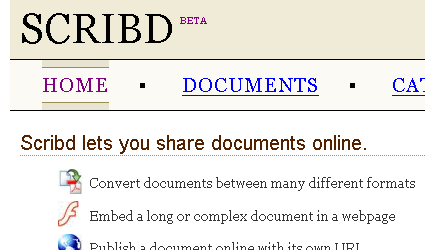
It was launched in 2006 and now has around 140,000 documents in its database. A browse of the groups contained within Scribd shows the extent of the collections with some very interesting vintage print adverts, material on Wen 2.0 and even some open text books. Trouble is that, as you might guess the adult section contains the most resources , some 17,000 making it a difficult resource to see used in schools.

This would seem to undermine Dan Pink's analysis of the changing nature of the aptitudes we need to develop as an improvement or promotion of more right brain thinking. To be fair Dan Pink does make it clear that both hemispheres of the brain as still important and the aptitudes associated with the left hemisphere are still vitally important, just that we need to recognise the importance of those attributes that are often cited as right brain ones.
Alistair Smith does confirm that the left and right hemispheres contain areas which perform specific functions and they differ in the way they process information, For example, the right deals with more global 'big picture' interpretations while the left deals with more local (detailed) ones. Alistair uses this example to demonstrate that the two work in concert and produce an integrated information processing system with each half making its contribution to the overall interpretation of a particular experience.
Dan Pink's arguments can be presented without the left/ right brain issue getting in the way as what he is pointing out is a need for particular competencies requiring more attention. Certainly there is a shift toward curriculum models that provide for a wider range of assessment types than we have been used to through SAT's so the debate. Alistair points out that educators and scientists are asking different questions. Therefore it seems sensible to assume that any curriculum that is developed or teaching approach that is adopted can only really be informed by drawing on the analysis and research undertaken by both to inform future approaches.

Alan November captured discussions with Dan Pink were he expands on his thinking as it relates to schools, their design and the education system. Alan's discussions are part of the November Learning Podcast series and are available by subscribing through iTunes.

This e-book explores Learning Spaces from the perspective of effective learning and how learner expectations may influence their development.
It also covers the roll of learning technologies in bringing together different groups of people and specialisms all of whom can impact on the learner and the learning that takes place. While the e-book looks at learning spaces other than Primary and high schools a lot of the basic ideas apply and the discussion surrounding the desire to create more flexible spaces, both the physical and virtual ones, is of real value.
There is useful debate about formal and informal physical spaces and the importance of striking the correct balance to create the 'correct' environments for learning. The book opens up the debate about the role of technology as part of the mix and suggests that while learners are have more access to technology and they are comfortable using it many are still not proficient. This presents real issues for those schools and other educational organisations that see e-learning as a key component of personalisation.
The many VLE type products out there may provide alternative routes but the assumption that students can use them straight off and value the experience is open to question. The book also explores the issues surrounding the notion of community and identifies some of the ways in which a well designed virtual learning space can contribute to the development of an effective learning environment. The full e-book (173kb) can be accessed on the main site which also contains a number of case studies and the book broken down by chapters.

Joinedupdesignforschools
This book, produced as the result of a series of projects run with young people in 60 schools, is a really fascinating journey through a design process.
Youngsters working with designers and as designers were able to influence the designs of everything from the appearance of learning spaces to the design of school uniforms.
The experience (thats what the book feels like) of accompanying their journey makes great reading and is great for anyone who wants to rethink the spaces we teach our kids in.
The Sorrel Foundation Site
http://www.thesorrellfoundation.com/v&a.html
The Innovations Unit - useful additional information
http://www.innovation-unit.co.uk/projects/third-party-projects/joinedupdesignforschools.html
The V&A Web Report
http://www.vam.ac.uk/school_stdnts/schools_teach/programmes/previous_events/joinedup/index.html


 Posts
Posts


