Welcome
Schools, colleges and university are just some of the places where learning takes place but school kids and students can spend a lot of their time in these spaces. There are other places where people learn, some through doing courses at work or online or even learning from others around them in all sorts of situations. The posts here are about learning spaces, writings about learning and technology and thoughts and ideas about all of these.
Posted by
Dave Thomson
at
13:38
In the UK some local authorities are working flat out to come up with designs for schools that will stand the test of time for the next thirty years. The UK government's Building Schools for the Future programme set out in 2003 with the grand vision to replace the secondary school stock throughout England over a fifteen year period.
Similar programmes are underway in other countries. Ask different people what the key characteristics of such schools will be and there are as many views as there are learners that will attend these schools.
It is clear that a single characteristic or feature is unlikely to dominate but there might well be a small number of vital ones - use the poll below to choose the three that appear to be the most important to you.
Posted by
Dave Thomson
at
15:38
What society wants from the education system is changing all the time although for many it still appears to provide more or less the same diet as we have seen for the past hundred years or so.
We are in a connected world and there are resources for learning in all sorts of formats along with the opportunity to communicate and collaborate with individuals and groups from around the world. Never before has there been something that had such an impact on the education process as has the advance in technology and the internet. We need to think carefully about how the use of technology will affect the design and delivery of the curriculum in our schools.
The question is how much will the curriculum be allowed to change? How much can we accommodate these new ways or working and how ready are our pedagogues to accomodate the use of technology to allow the changes to take root?
Some would suggest that nothing much will change. The subjects we are used to have been around for ages. Others argue that young people now have more choice than they have ever had and that the social networks and other communities online will be the future for formal education.
Most probably we will end up somewhere between the two extremes. We will probably have schools for a long time to come, they will have teachers (but perhaps fewer specialists), we will have more adults working with kids (teaching assistants and mentors from outside the school etc), we will have online spaces (but these may be simply extensions of a particular classroom and not dynamic communities). We are already seeing a mix of provision with some internships or work placements as part of the learner's programme and we are seeing ideas for building the curriculum to deliver the standards that seem to be a political imperative and yet have been formed into a more project based structures.
The nature of educational change is that it is normally a slow process. That said the rapid development of alternatives as technological provides interesting and attractive alternatives will result in huge pressure to speed the change process. We await with interest the results.
Posted by
Dave Thomson
at
23:42

Tailoring the education system to individuals does tend to make us think about learning styles even though there are huge arguments about just what these are, how they can be assessed and what the outcome of assessment can be used for to shape the learning experience in our schools.
Personality profiling is also thought by some to be the key to understanding individual needs or to help individuals understand more about the way they learn.
There are a number of profiling tools that have been developed for exploring the various characteristics of individuals and how these may inform the sort of learning experience they need. The debate will go on about their value and use in terms of the learning process. What is clear is that their use does raise the profile of the different ways people interact or will respond to differing learning situations. They are useful to the teacher in that they help to build a profile of the learner and flag up difference that need to be catered for. They are useful to the learner in that they encourage learners to reflect on the way in which they go about learning.
Among the raft of online assessments are
YourPreferences, which is based on the work of
Carl Jung on Personality profiling,
VARK, which has been developed by Neil Fleming and is about the way individuals like to access information and finally the
ubiquitous Multiple intelligences theory developed by Howard Gardener. You can try these tools out and see what it tells you about yourself or your students
.
Posted by
Dave Thomson
at
23:20

Establishing a vision for the school of the future is challenging educators around the world. The critical mix of curriculum, technology and accommodation supported by various knowledgeable adults is stretching the minds of educators, architects and designers and governments around the world appear to be searching for the elusive mix.
Maybe there isn't a mix as such and different 'mixes' will be needed for different types of learners - true personalisation.
The
Big Picture Company is an organisation aiming to
fundamentally change the nature of learning. The Met School (mentioned elsewhere in this blog) is a Big Picture school and has got about as close as you can get to a personalised curriculum. The
adage 'One Student at a Time' is taken very very
seriously.
The photograph below shows the timetable - not a list of subject sessions one after the other but a series of advisory sessions to support learners with their personalised programmes. Subject knowledge does feature in the study programmes but they are shaped to apply to the particular requirements. Where a number of students are following programmes that require the same knowledge base then they are taught as a group.

Self study is a key component as is reporting their progress to their peers and adult observers in the advisory sessions. These presentations, far from being easy, are demanding and do put the student under pressure.
The MET is one of the Big Picture Company schools and they have achieved retention rates that are the envy of the state. The students I met were self confident, articulate and had a world view that was very impressive. If this is personalised learning then the Big Picture Schools have the sort of ideas and experience that it would be worth any budding 21st Century schools to hear about.
Posted by
Dave Thomson
at
09:39
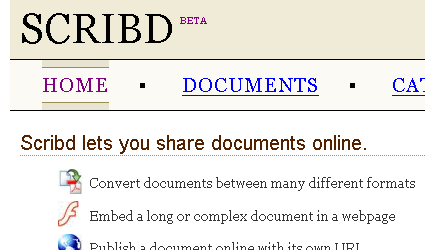
The description of Scribd as the YouTube for documents is about right. Many of us will be used to sites such as FanFiction but Scribd aims to create the world's largest open library of documents.
It was launched in 2006 and now has around 140,000 documents in its database. A browse of the groups contained within Scribd shows the extent of the collections with some very interesting vintage print adverts, material on Wen 2.0 and even some open text books. Trouble is that, as you might guess the adult section contains the most resources , some 17,000 making it a difficult resource to see used in schools.
Scribd has some materials from NASA and from Project Guttenburg plus a number of books that are still covered by copyright so its not exactly an example of acceptable practive when trying to convey to young people the need to respect the ownership of written work.
Perhaps the idea is a good one but it is not something that I could see being used in classrooms.


 Posts
Posts


